An English to French Vocabulary for Kids Workbook: More Than Just a Book
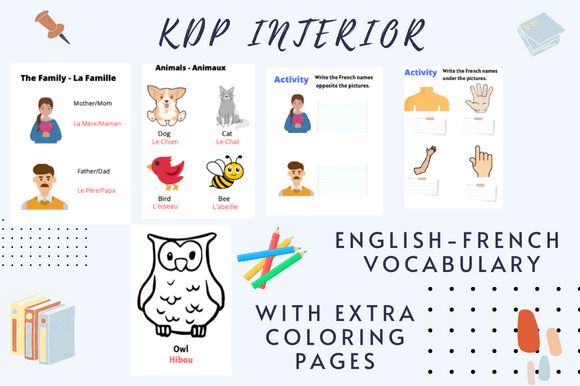
In a world where bilingualism is increasingly seen as a fundamental asset, the tools we give our children to learn a second language must be as effective as they are engaging. An English to French Vocabulary for Kids workbook represents a significant evolution in this space, moving beyond traditional textbooks to become a hands-on, creative learning companion. This isn’t merely a list of translated words; it’s a structured, 72-page journey designed to build foundational language skills through activity, play, and visual discovery.
The relevance of such a resource is clear. For parents, educators, and creators, supporting a child’s journey into French requires materials that fit modern learning habits. Children today engage with information interactively. A workbook that combines French words Activity pages coloring pages all together leverages multiple modes of learning—visual, kinesthetic, and cognitive—to reinforce memory and make the process enjoyable. This approach aligns with contemporary educational research that emphasizes multi-sensory engagement for deeper and more lasting knowledge acquisition.
The Shift in Language Learning Tools
The landscape of educational materials has undergone a quiet revolution. Driven by the needs of busy families and the realities of modern classrooms, resources are becoming more integrated and self-contained. A single, well-designed workbook can now serve as a comprehensive unit of study, eliminating the need for multiple disparate sheets and books. This trend towards consolidation is perfectly embodied in a Vocabulary workbook for bilingual kids that offers a complete curriculum spine for introductory French.
Specifically, the format—an Amazon KDP interior set at 8.5 x 11 inches—speaks directly to creator economics and user expectations. This standard size is familiar, practical for printing, and provides ample space for varied activities without feeling cramped. For the independent author or educator publishing through Amazon KDP, it represents a proven, market-friendly specification that meets professional quality standards while remaining accessible to produce. For the end user, it delivers a substantial, physical product that feels like a "real book," fostering a sense of commitment and progress for the child.
Why Vocabulary-Focused Activity Books Are Gaining Attention
People are paying more attention to targeted vocabulary building because it addresses a core challenge in language learning: retention. Memorizing lists is ineffective for young minds. Instead, embedding vocabulary within puzzles, matching games, and coloring pages creates contextual hooks. When a child colors a picture of a "chat" (cat) and writes the word, they associate the French term with a visual image and a physical action. This multi-step process builds stronger neural connections than passive reading alone.
This evolution from rote memorization to active creation reflects a broader shift in pedagogy. Parents and educators seek tools that encourage the child to be a maker, not just a receiver, of knowledge. A 72-page activity book provides a structured sequence, offering a clear path from simple nouns (food, animals) to more complex phrases, all while maintaining a playful atmosphere. The gradual progression prevents frustration and builds confidence, which is crucial for sustaining a child’s motivation over time.
Practical Implications for Creators and Users
For the creator—whether a professional educator, a bilingual parent, or a freelance designer—developing an English to French vocabulary workbook requires a deep understanding of both pedagogy and design. The interior layout must balance educational rigor with aesthetic appeal. Each page should have a clear learning objective, yet feel like an invitation to play. The integration of coloring sections isn’t filler; it’s a strategic tool for downtime within the learning sequence, allowing for consolidation without cognitive overload.
For the user—the adult purchasing the book—the practical value lies in its utility and independence. This workbook is a ready-to-use solution. It requires no additional preparation from the parent or teacher. A child can work through it with minimal guidance, making it perfect for supplementing school lessons, for homeschool settings, or for enriching summer breaks. The 72-page length is significant; it promises substance without being overwhelming, suggesting a project that can be completed over a semester or summer, providing a tangible sense of accomplishment.
Integrating Modern Expectations into a Classic Format
Today’s parents and educators expect learning materials to be not only educational but also aligned with a child’s holistic development. An activity book that blends vocabulary with coloring caters to this expectation by supporting fine motor skills, creativity, and focus alongside language acquisition. It acknowledges that learning is not a siloed activity but part of a child’s broader growth. The forward-looking design of such workbooks takes a realistic approach: it uses technology (through platforms like Amazon KDP for accessible publishing and distribution) to deliver a fundamentally hands-on, analog experience that benefits a child’s development.
The market preference is clear: products that deliver multifunctional value. A book that is purely a coloring book or purely a vocabulary list has limited appeal. Combining them into a single, cohesive 72 pages activity book for children who wants to learn French words meets a complex need efficiently. It’s a product that fits into modern, often time-poor lifestyles, offering a high-quality, focused learning session within a single resource.
Building a Effective Learning Journey
A successful English to French vocabulary workbook follows a logical and supportive progression. Early pages might focus on high-frequency, concrete nouns with clear illustrations. Subsequent sections introduce verbs and simple adjectives through sentence-completion activities or scene labeling. Coloring pages are interspersed strategically, often themed to the vocabulary cluster just learned—like a page of "les animaux de la ferme" (farm animals) to color after completing the farm vocabulary exercises.
The key is variation and rhythm. One page might be a word-matching grid, the next a "find and color" the objects in French, and another a simple crossword. This variation prevents boredom and caters to different learning moods a child might have. It also allows the book to be used flexibly; a child doesn’t need to proceed in strict order but can choose an activity that suits their interest that day, all while staying within the thematic vocabulary framework.
The ultimate recommendation for anyone utilizing or creating such a resource is to prioritize clarity and joy. The instructions should be simple, sometimes using icons or examples. The artwork should be charming and clear, not overly complex. The goal is to minimize barriers to starting the activity so that the child’s energy is directed entirely toward engaging with the French words. When done well, this turns a learning workbook into a cherished activity book, a place where a child willingly returns, building their French vocabulary through the simple, powerful act of play.