The Address Log Book KDP Interior: Evaluating a Ready-to-Publish Solution
For self-publishers using Amazon’s Kindle Direct Publishing (KDP) platform, interior files represent a critical piece of the puzzle. While creating a unique book from scratch is one path, many seek efficient, professional templates to accelerate their business. An Address Log Book KDP Interior is a specific type of template designed for publishing low-content or no-content books, such as address journals. This article explores what this product entails, its distinct characteristics, and how it compares to other approaches in the KDP ecosystem.
Understanding the Core Product
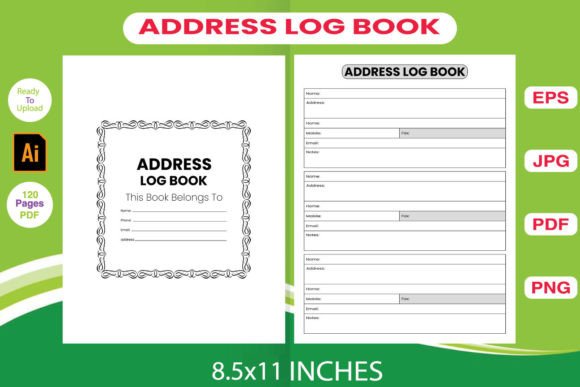
At its heart, the Address Log Book KDP Interior is a digital file package. It is marketed as a tested, ready-to-upload interior for an address log book. The standard offering includes a print-ready PDF formatted for a specific trim size, often 8.5 x 11 inches. Its defining feature is the claim of being "KDP tested," meaning the upload process and print quality have been validated against Amazon’s requirements. Beyond the PDF, key assets like editable EPS vector files (for Adobe Illustrator), transparent PNGs, and high-resolution JPGs are typically included. This multi-format approach is what sets many such interiors apart from simpler PDF-only options.
What Makes This Interior Distinct
Several attributes differentiate a comprehensive Address Log Book KDP Interior from a basic template. First is the vector file support. EPS files allow for true scalability and editing; you can change the size, modify graphics, or adjust layout elements without loss of quality, which is a significant advantage for customisation. Second, the inclusion of files with transparent backgrounds (PNG) provides flexibility for cover design or integration into other projects. Finally, the package often offers multiple page count variations (e.g., 100, 110, 120 pages), giving publishers a choice to match market preferences without manually adding or removing pages.
Comparing Development Approaches for KDP Interiors
When considering how to produce an address log book for KDP, publishers have several broad paths. Evaluating the Address Log Book KDP Interior against these alternatives highlights its specific role.
- Custom Design from Scratch: Using software like Adobe InDesign or even Microsoft Word to design every page. This offers total creative control but demands significant time, design skill, and knowledge of KDP technical specifications (bleed, margins, DPI). It’s the opposite of a ready-to-use solution.
- Basic Template Purchase: Buying a single, fixed PDF template. This is quicker than custom design but offers limited flexibility. If the trim size isn’t perfect or you need to add a logo, alterations can be cumbersome and degrade quality.
- Multi-Format Interior Packages: This category includes products like the Address Log Book KDP Interior. They balance ready-to-use convenience with some editable potential. The tradeoff is that while more flexible than a basic PDF, they still require vector editing software (like Illustrator) for substantial changes, which not all users possess.
- Subscription-Based Generators: Some online services offer dynamic template generation for various low-content books. These can be excellent for rapid testing of many formats, but the output files may be less editable or might not include the native vector source files, potentially locking you into the service’s ecosystem.
Strengths and Practical Benefits
The primary strength of a well-prepared Address Log Book KDP Interior is efficiency. For a publisher familiar with KDP’s upload process, having a tested interior means reducing the risk of rejection due to formatting errors. The 300 DPI quality assurance and clear bleed settings (often "No Bleed" for such interiors) address common technical pitfalls. The multiple file formats serve different purposes: the PDF for instant upload, the EPS for future resizing or branding, and the bonus JPGs perhaps for marketing materials. This can streamline the journey from purchase to a live Amazon listing.
Tradeoffs and Considerations
No solution is perfect for every situation, and understanding the tradeoffs is vital for an informed decision.
One consideration is design originality. Since these interiors are sold to many publishers, the core layout will not be unique. Using the editable EPS files to alter colors, fonts, or graphics can mitigate this, but it requires additional effort and skill. If brand distinctiveness is a high priority, a custom design might be a better long-term investment.
Another factor is the specificity of the product. An Address Log Book KDP Interior is designed explicitly for an address log. If your publishing strategy involves quickly diversifying into other low-content niches (meal planners, fitness journals), purchasing a separate interior for each type could become costly compared to a versatile template generator or developing your own reusable design system.
Finally, the "KDP tested" claim is valuable, but it’s wise to understand its scope. Testing typically confirms the PDF meets KDP’s print standards for the stated trim size. It does not guarantee market success or sales, and it may not cover every possible trim size variation if you later use the EPS to resize.
When This Interior Is the Right Fit
The Address Log Book KDP Interior package aligns well with certain publisher profiles. It is a strong candidate for someone who:
- Has intermediate technical comfort with KDP but lacks advanced graphic design skills.
- Values speed to market and wants to validate a niche (like address logs) with a professional-looking product quickly.
- Possesses access to Adobe Illustrator or similar vector software, or plans to hire a designer for minor customisations using the provided source files.
- Prefers owning a set of static files outright over a subscription model.
A realistic example: a publisher researching the low-content book market discovers that address organizers have steady demand. They choose this interior to upload a quality product within days, using the PNG files to quickly create a matching cover in Canva. Later, if the book sells well, they use the EPS file to create a 6x9 inch version for a different audience, leveraging the vector scalability.
When Another Option Might Be Needed
Conversely, there are scenarios where a different approach may be more suitable than a pre-made Address Log Book KDP Interior.
If you are building a cohesive series of journals under a strong personal brand, where every interior must share unique stylistic elements, a custom-designed template scaled across your entire catalog is often more effective. Similarly, if you have no access to vector editing tools and need to make significant alterations (like changing the page count layout fundamentally), a basic PDF template or a subscription generator that outputs your exact specifications might be easier, despite having other limitations.
For publishers who are strictly testing concepts with minimal upfront investment, even free templates or very basic, low-cost PDFs might serve the initial purpose. The advanced features of a full interior package become valuable when you commit to a niche and seek to optimize quality and adaptability.
Making an Informed Decision
Choosing a resource for your KDP interior involves weighing factors like time, skill, budget, and strategic goals. A product like the Address Log Book KDP Interior occupies a specific middle ground: more capable than a static template, less resource-intensive than a full custom design. Its value is particularly pronounced in the editable, multi-format offering.
Before deciding, evaluate your own capabilities. Do you have the software to use the EPS files? Is your immediate goal speed or uniqueness? Consider also the longevity of your project. The resizable nature of vector files can offer future utility, making such a package a potential asset for more than one publication.
Ultimately, the KDP landscape offers multiple valid paths. Whether a ready-made interior, a custom design, or a generative tool is best depends on your individual context. By understanding the distinct features, strengths, and tradeoffs of options like the Address Log Book KDP Interior, you can select the approach that aligns with your publishing objectives and resources, moving forward with a clearer, more practical perspective.