Your Guide to Choosing the Right Medical Test Journal Interior
Creating a professional medical test journal is an excellent way for healthcare professionals, students, or researchers to organize vital data, patient observations, and study results. For many, the most practical route is using a pre-designed template for Amazon KDP (Kindle Direct Publishing). A product like the MEDICAL TEST JOURNAL KDP Interior offers a ready-made solution. However, selecting and using such a digital template involves more than just clicking "download." Choosing poorly can lead to hours of frustrating reformatting, a substandard final printed book, or even rejection from the KDP platform. Understanding the specifics of what you're buying and how to apply it correctly is the key to a smooth, successful publishing project.
Overlooking the Critical Importance of File Formats
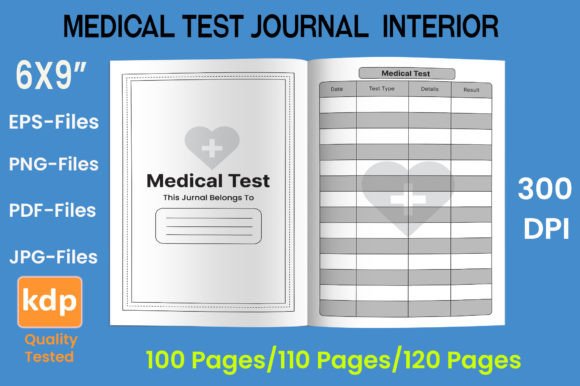
A common initial mistake is focusing solely on the visual design of the MEDICAL TEST JOURNAL KDP Interior without understanding the included file formats. This package typically includes a Print PDF, EPS files, PNGs, and JPGs. Each serves a distinct purpose. The ready-to-upload Print PDF is the final, tested file for KDP. The EPS and PNG files, with their editable and transparent backgrounds, are for customization. If you download the files and immediately upload the PNG or JPG to KDP, your project will fail because those are not the correct print-ready formats. Similarly, if you plan to modify the interior—perhaps to add your clinic's logo or adjust a section—you need the editable EPS files. Not checking which formats are included, or not understanding their use, is a fundamental error that stops your project before it begins.
A better approach is to assess your needs before purchase. If you require no changes, the Print PDF is your immediate tool. If you need to customize, ensure the package includes the original source files (like EPS) and that you have software (such as Adobe Illustrator) capable of opening them. This small bit of forethought saves considerable time and ensures you have the right tools for your specific job.
Assuming "No Bleed" Means No Special Requirements
The MEDICAL TEST JOURNAL KDP Interior specifies a trim size of 6x9 inches and No Bleed settings. Many beginners misinterpret "No Bleed" as meaning they can ignore layout boundaries. In print design, "No Bleed" simply means the design elements do not extend to the edge of the page, intended to be trimmed off. However, all KDP interiors still require proper margins. A quality template will have these margins correctly built-in. The mistake here is not verifying that the interior follows Amazon KDP's margin guidelines for its stated trim size. If you later add your own content into the editable files and place text too close to the edge, it could be cut off during printing or look unprofessional.
Always use the provided Print PDF as your quality reference. Open it and visually check that text and graphics are well-contained within the page, with a clear, consistent border of white space around the edges. When customizing, respect those existing margin guides. This attention to detail guarantees your journal's content is safe and readable in its final printed form.
Ignoring the "KDP Tested" Assurance
The product description mentions the files are KDP tested. This is a crucial point often overlooked. Testing means the designer has uploaded the exact PDF to the KDP system and verified it passes all technical requirements without errors or warnings. This pre-vetting is invaluable. The common mistake is to treat this as a minor feature, or to assume any 6x9 PDF will work. In reality, KDP has precise specifications for resolution, font embedding, and color space. Using an untested interior, even one you design yourself, risks upload errors, a lengthy correction process, or poor print quality.
Your practical advice is to prioritize products that are explicitly KDP tested, like this MEDICAL TEST JOURNAL KDP Interior. It means you are acquiring a file that has already cleared the technical hurdles. However, you should still perform your own check. Before uploading, preview the provided PDF thoroughly on your own screen, checking for any obvious formatting oddities that might have been introduced if you used the editable files. Trust the tested status, but complement it with your own final review.
Choosing the Wrong Page Count for Your Needs
This interior offers variations like 100, 110, or 120 pages. Selecting a page count based on a guess rather than a plan is a typical oversight. A medical test journal might be used for a single long-term study, daily clinic notes, or student lab work. Each use dictates a different required capacity. Choosing a 100-page journal for a year-long daily tracking project will leave you with an incomplete record. Conversely, choosing 120 pages for a short-term, small-scale project results in a bulky, half-empty book that feels wasteful and is unnecessarily costly to print.
Map out your intended use realistically. Estimate how many entries per week you'll make and multiply that by the project's duration. Add pages for introductory notes, indexes, or reference tables. This simple calculation guides you to the most appropriate page count option, ensuring your printed journal is perfectly sized for its purpose, enhancing both usability and satisfaction.
Underestimating the Value of a 300 DPI Print PDF
The specification Quality 300 DPI (Dots Per Inch) is a technical term that directly impacts the physical quality of your book. DPI refers to the resolution of the images and graphics within the file. A common misunderstanding is that this only matters for photo-heavy books. Even a text-based journal like this relies on clean, sharp lines for tables, charts, and any graphical elements. A file with lower resolution (like 72 DPI) would result in blurry or pixelated print output, making the journal look amateurish and difficult to read.
The provided Print PDF at 300 DPI guarantees professional print sharpness. When you receive the files, avoid the mistake of replacing high-resolution graphics within the editable files with low-resolution ones from the web. If you customize, maintain the same high-quality standards. Your readers, whether patients, colleagues, or reviewers, will perceive the quality of your work through the quality of your published journal.
Not Planning for the Practical Use of Bonus Files
Bonus files like high-resolution JPGs or PNGs with transparent backgrounds are often dismissed as mere extras. For a MEDICAL TEST JOURNAL KDP Interior, these can be strategically useful. A transparent PNG of the journal's cover design or internal layout elements can be repurposed for marketing materials—social media posts, website graphics, or promotional flyers for your book. The mistake is downloading the pack, using only the PDF, and leaving these assets unused.
Think holistically about your publishing project. If you plan to market your journal, these bonus graphic files provide a consistent visual identity across all mediums. Extract them, store them in a project folder, and use them to create a cohesive promotional campaign. This turns a simple template purchase into a complete branding toolkit.
In summary, the MEDICAL TEST JOURNAL KDP Interior is a robust template designed to streamline your publishing process. By avoiding these common pitfalls—misunderstanding file formats, neglecting print specifications, ignoring the tested status, guessing on page count, compromising on resolution, and overlooking bonus assets—you move from a potentially frustrating experience to a confident, efficient one. Always start with a clear plan for your journal's purpose, carefully review the product's specifications against that plan, and use each included file to its full advantage. This thoughtful approach ensures the final product you upload to KDP is not only technically correct but perfectly suited to serve its important role in documenting medical tests and data.