Essential Considerations for Scuba Dive Log Book KDP Interior Files
For anyone looking to publish a professional dive log book through Amazon's Kindle Direct Publishing platform, the availability of pre-designed interior files can significantly streamline the process. The term Scuba Dive Log Book KDP Interior typically refers to a digital product package containing the formatted pages and layout for a book's content, ready for upload and printing. This article examines the practical value and characteristics of such a product based on common specifications, focusing on its utility for creators rather than its promotional claims.
Understanding the Core Product Offering
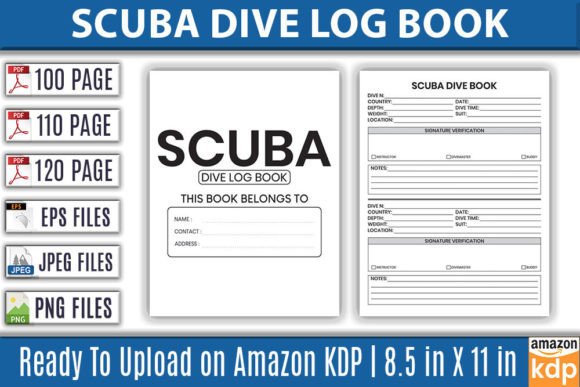
A Scuba Dive Log Book KDP Interior is not a physical book but a set of digital files designed to become one. Its purpose is to provide a complete, tested page layout that publishers can use directly, avoiding the time and technical skill required to design a log book from scratch. The key characteristics outlined—such as 100, 110, or 120-page options, an 8.5×11 inch trim size, and inclusion of multiple file formats—point to a product meant for flexibility and immediate application.
The primary strength of such an offering is its readiness. The mention of being KDP tested is crucial; it indicates the files have been validated against Amazon's printing requirements, which can be a common hurdle for new publishers. This pre-validation reduces the risk of formatting errors, blurry graphics, or margin issues upon submission, providing a layer of reliability.
Evaluating Quality and Practical Usability
Quality in digital interiors for print is defined by several technical factors. A 300 DPI resolution ensures that any graphical elements or text will appear sharp in the final printed book. The No Bleed setting specifies the layout is designed for standard interior pages without extending graphics to the edge of the page, which is appropriate for text-heavy log books. This simplifies the printing process and is typically what KDP requires for simple interiors.
The inclusion of multiple file formats enhances usability and long-term value. A Print PDF is the essential file for KDP upload. However, providing editable original files like EPS, and transparent PNGs or high-resolution JPGs, offers significant flexibility. A publisher can modify details, adjust branding, or reuse elements for marketing materials. This transforms the product from a static template into a adaptable asset, increasing its effectiveness for professionals who may wish to customize or create derivative works.
Performance in Real-World Publishing Scenarios
In practice, using a Scuba Dive Log Book KDP Interior can accelerate the publishing timeline dramatically. A creator—perhaps a dive instructor, a dive travel blogger, or a small business selling niche publications—can focus on marketing and distribution rather than learning graphic design software. The consistent, clean presentation of a pre-formatted log book, with structured pages for dive details, dates, locations, and notes, meets the functional need reliably.
However, its performance is contingent on the publisher's specific goals. The product appears optimized for straightforward, functional log books. Its large trim size suggests a focus on ample writing space, perhaps suitable for detailed data entry. For a publisher aiming for a highly stylized, artistic, or uniquely branded log book, this interior might serve as a foundational starting point requiring customization via the provided editable files. Without those editable assets, its utility would be markedly lower.
Audience Fit and Beneficial Use Cases
Several groups stand to benefit most from a ready-made Scuba Dive Log Book KDP Interior. Entrepreneurs and small business owners in the diving niche can use it to quickly add a physical product to their offerings without a large design investment. Educators and dive professionals might create branded log books for their students or clubs. Freelancers and creators with expertise in diving but not in book design can monetize their knowledge by publishing a companion log.
The situations where this product is most advantageous include: launching a first KDP product to learn the process with a lower technical barrier; needing a time-efficient solution to capitalize on a market opportunity; or requiring a reliable, print-ready base that can be lightly customized for different dive themes or regions. It is less suitable for those seeking a highly unique, avant-garde design or for projects where the interior layout needs to be intricately tied to a complex visual identity from the outset.
Key Strengths in a Creator's Workflow
- Speed to Market: Eliminates weeks of layout design and testing.
- Technical Assurance: Pre-tested files mitigate KDP upload failures.
- Format Flexibility: Multiple file types support both immediate use and future edits.
- Scale Options: Different page counts (100, 110, 120) allow for tailoring book length to perceived customer value.
Professional Observations and Limitations
From a professional standpoint, the value of such an interior package hinges on the quality of its execution beyond the listed specs. For instance, are the page layouts logically organized for a diver's use? Is the typography clear and readable? Does it include essential log sections like depth, time, conditions, and equipment notes? The product description suggests a functional approach, but the ultimate effectiveness depends on these intelligent design choices within the files.
A potential limitation is the dependency on a single trim size. The 8.5×11 inch format is standard but may not appeal to all markets; some divers might prefer a more compact, portable size. Furthermore, while "ready to upload" is a significant benefit, publishers must still correctly handle cover design, ISBN assignment, and pricing—the interior file does not solve the entire publishing puzzle. It is a crucial component, not a complete solution.
Practical Recommendations for Prospective Users
Before acquiring a Scuba Dive Log Book KDP Interior, clarify your needs. If you require minimal customization, confirm the Print PDF's layout matches your vision. If you plan to modify it, verify the editable EPS files are indeed usable in software you access. Consider how the page count aligns with your pricing strategy; a longer book might justify a higher price point. Finally, always use the provided files as a starting point for your own quality check—preview them thoroughly, perhaps even creating a test print-on-demand copy to ensure final output meets your standards.
Concluding Assessment for Project Fit
The decision to use a Scuba Dive Log Book KDP Interior file set is ultimately a balance between efficiency and customization. For creators whose priority is to publish a professional, functional dive log with minimal design overhead and proven print reliability, it represents a practical and valuable resource. Its bundled formats support both immediate launch and future iteration, offering good long-term value. For those whose project demands a completely original layout or a specific trim size deviation, it may serve only as a reference or require substantial modification. By objectively assessing your technical capacity, time constraints, and branding requirements, you can determine if this type of pre-designed interior aligns with your publishing goals and workflow.