The Role of Free Science Vocabulary Matter Puzzles in First Grade Education
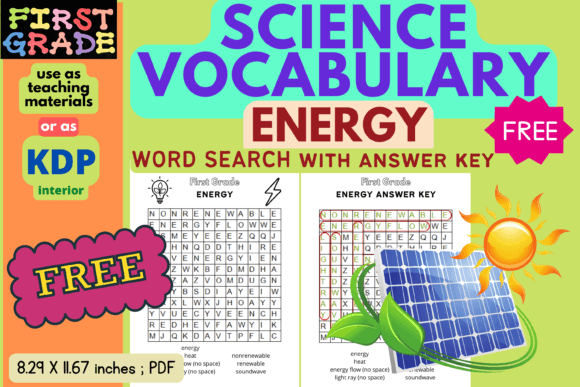
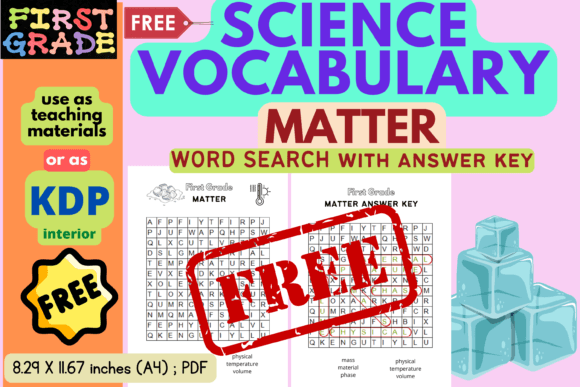
For educators, parents, and homeschooling facilitators seeking effective supplementary materials, the landscape of elementary science resources is vast. Among these, the FREE Science Vocabulary Matter Puzzles—specifically the word search puzzle with answer key—present a distinct, focused option. This downloadable PDF, formatted for A4 paper (8.29 x 11.67 inches) and in black and white, is designed to help first graders get familiar with foundational science vocabulary while having fun. Understanding its place within the broader ecosystem of teaching tools requires a practical look at its design, application, and the tradeoffs involved when choosing such a specialized resource.
What Distinguishes This Puzzle Resource
The core offering here is a single, concentrated activity: a word search puzzle centered on matter-related vocabulary. Its distinct characteristics are its format and intent. As a digital download, it offers immediate access and unlimited printing, aligning with the needs of budget-conscious or remote teaching scenarios. The A4 size ensures compatibility with standard printers globally, while the black-and-white design keeps printing costs minimal and allows for student customization through coloring. The inclusion of an answer key provides a straightforward verification tool for the instructor, promoting independent use or quick assessment. Unlike broader workbooks or unit plans, this resource is a precise instrument targeting one specific goal—vocabulary reinforcement through a game-like format.
Comparing Formats and Pedagogical Approaches
When evaluating teaching materials for early science concepts, one must consider the spectrum of available formats. Comprehensive curricula, interactive online games, hands-on experiment kits, and printable worksheet bundles all serve different purposes. The FREE Science Vocabulary Matter Puzzles falls squarely into the category of printable supplemental practice. Its primary comparison lies with other vocabulary-building tools.
Strengths of this focused puzzle include:
- Low Cognitive Load: For first graders, a word search offers a familiar, engaging activity that builds word recognition without the pressure of complex instructions.
- Vocabulary Isolation: It dedicates full attention to terms like “solid,” “liquid,” or “gas,” allowing for repeated visual exposure.
- Flexibility: It can be used as a warm-up, a quiet independent activity, a homework assignment, or part of a larger matter-themed packet.
- Cost and Accessibility: Being free removes financial barriers, and the PDF format means no physical storage or shipping wait times.
Tradeoffs and limitations are equally important to note:
- Limited Scope: A single word search does not teach concepts; it reinforces terms. It assumes prior introduction to the topic of matter.
- Passive Engagement: Compared to hands-on activities where children manipulate states of matter, this is a paper-based, visual exercise. It builds literacy but not necessarily experiential understanding.
- Standalone Utility: As a solitary resource, it is insufficient for a full lesson. Its value is maximized when integrated into a richer lesson plan including discussion, observation, and experimentation.
Identifying the Best-Fit Situations
The decision to utilize the FREE Science Vocabulary Matter Puzzles hinges on the user’s specific context and educational objectives. It may be the right choice in several realistic scenarios.
For the homeschooling parent assembling a variety of resources from different sources, this free puzzle can efficiently fill a slot for vocabulary practice without requiring a full workbook purchase. For the classroom teacher looking for a quick, printable activity to consolidate a week’s lessons on matter, it serves as a convenient review tool. For tutors or after-school program coordinators, it provides a structured yet fun task that requires little preparation.
However, situations where another option might be necessary are clear. If the goal is to introduce the concept of matter from scratch, a resource with explanatory content, images, and simple experiments is required. If the student struggles with reading or letter recognition, a more tactile or pictorial activity would be more appropriate. Furthermore, if long-term, sequential learning is the aim—covering matter, energy, life science, and space science as mentioned in the store’s other categories—a coordinated curriculum or bundle would offer more coherence than individual, disconnected puzzles.
Practical Integration and Alternative Paths
To use this resource effectively, consider pairing it with other elements. For example, after a simple kitchen experiment showing ice melting and water evaporating, the word search can help cement the vocabulary encountered. It could also be combined with a simple matching exercise where students draw examples next to each found word.
When the FREE Science Vocabulary Matter Puzzles does not fully meet needs, the natural alternatives are within the same store’s offerings, such as materials for EARTH SCIENCE, ENERGY, or LIFE SCIENCE. These might provide a more comprehensive thematic coverage. Alternatively, educators might look towards interactive digital platforms that offer adaptive learning paths or physical science kits that prioritize sensory learning. The choice between a free, printable, vocabulary-focused puzzle and these other options fundamentally balances factors of budget, teaching style (digital vs. analog, active vs. passive), desired depth of understanding, and the need for integrated lesson planning.
Making an Informed Selection
The value of any educational resource is determined by its fit within a larger learning strategy. The FREE Science Vocabulary Matter Puzzles is a specialized tool with a clear, narrow function. Its advantages of zero cost, instant access, and focused vocabulary practice are compelling for supplementing existing instruction. Its limitations in scope and experiential engagement mean it is not a stand-alone solution.
For adults researching resources—whether for KDP interior creation, classroom enrichment, or home education—the decision-making process should weigh these factors. If the immediate need is a low-cost, printable activity to reinforce first-grade matter vocabulary, this puzzle is a strong candidate. If the need is for a full unit plan, conceptual teaching, or multisensory exploration, then this resource, while potentially useful as a component, would require pairing with more substantive materials. Ultimately, exploring the range of available tools, from free puzzles to comprehensive curricula, allows for a tailored approach that best supports the young learner’s journey into science.